Email:alexander@dayiforgingtech.cn
Language: 



Different forging alloy materials have distinctly different requirements when it comes to selecting a hydraulic press, primarily due to the material's inherent deformation resistance, plasticity, hot working window, thermal conductivity, and sensitivity to deformation rate (strain rate).
When selecting a hydraulic press, a "material-process-equipment" matching process is essential. The following are key considerations for different alloy materials:
Overview of Key Consideration Factors
Material properties | The main factors influencing the selection of a hydraulic press. |
Deformation resistance / Flow stress | Nominal force (tonnage): The deformation resistance of the material at the forging temperature directly determines the required pressure. High-temperature alloys and titanium alloys require extremely high tonnage. |
Hot working window | Control accuracy and stability: The narrower the processing window (such as for titanium alloys and high-temperature alloys), the more precise the control requirements for slider speed and holding time become. |
Plasticity/Malleability | Strain rate sensitivity: Some materials (such as aluminum alloys) are insensitive to the rate of deformation, while others (such as high-temperature alloys) are very sensitive and require slow deformation. |
Forging temperature | Mold Preheating and Cooling Systems: High forging temperatures (such as >1000°C) require more powerful mold heating and cooling systems. |
Thermal conductivity | Deformation speed and mold thermal management: Poor thermal conductivity (such as in titanium alloys) can easily lead to localized overheating of the mold, requiring better mold cooling. |
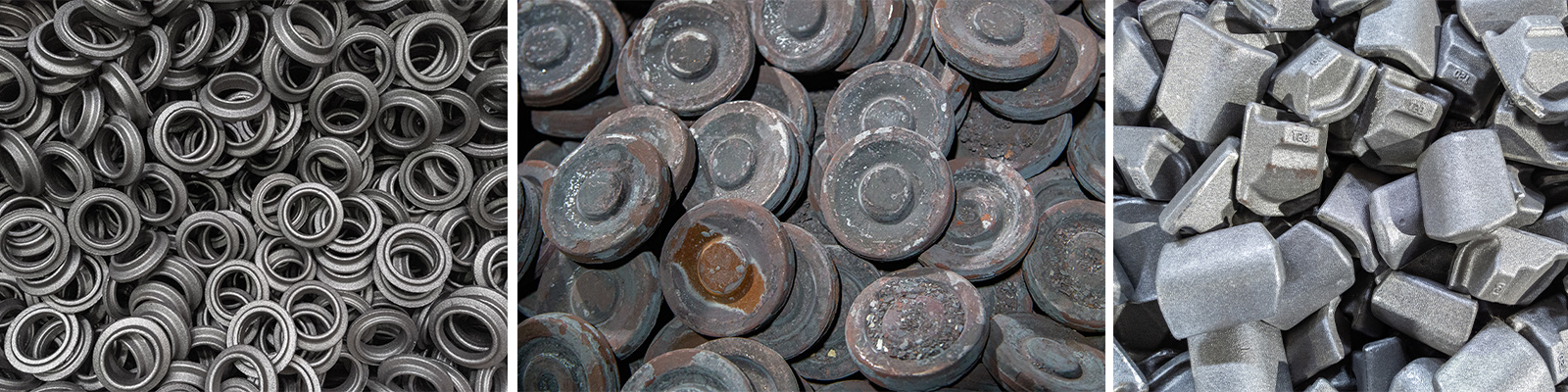
Tonnage Requirements: High. Titanium alloys have high deformation resistance at forging temperatures, especially during β forging.
Speed Requirements: Highly sensitive to deformation rate. Requires low, stable deformation speeds. Rapid deformation leads to temperature rise and localized shearing, causing "β embrittlement." Therefore, controlled-speed hydraulic presses must be used, not hammers or mechanical presses.
Key Considerations:
Isothermal/Hot Die Forging: This is the preferred process for forging complex titanium alloy components. It requires the hydraulic press to have precise temperature control capabilities in a closed space – the dies need to be heated to a temperature close to that of the billet (760-980°C), and high-temperature die materials (such as TZM molybdenum alloy) must be used. The hydraulic press frame and slide need thermal insulation protection.
Strain Control: Requires the hydraulic press to have very precise displacement sensors and servo control systems to achieve constant strain rate forging.
Poor Thermal Conductivity: Easily causes localized hot spots in the dies, requiring a robust internal cooling channel design for the dies.
2. Nickel-Based High-Temperature Alloys
Tonnage Requirement: Extremely high. These alloys have the highest deformation resistance among all forged materials, requiring the largest hydraulic presses (tens of thousands of tons).
Speed Requirement: Extremely sensitive to deformation rate. Must use very slow strain rates ("creep" deformation mechanism) to avoid cracking. This is the absolute domain of isothermal forging.
Key Considerations:
Isothermal Forging is Standard: Die temperature is the same as or close to the billet temperature (up to 1150°C). The hydraulic press must be a dedicated isothermal forging press, equipped with an ultra-high temperature die heating system (often using induction heating or resistance heating) and comprehensive thermal protection.
Ultra-Precise Control: Requires a multi-channel, high-precision closed-loop servo control system for millisecond-level control of pressure, speed, and displacement.
Environmental Control: To prevent alloy oxidation, forging is often performed in a protective atmosphere (such as argon), and the hydraulic press workbench may require sealing or environmental control devices.
3. Magnesium Alloys
Tonnage Requirements: Very low. Magnesium alloys are among the most easily deformable metals.
Speed Requirements: Sensitive to speed; low-speed hydraulic presses are generally used to avoid overheating due to deformation heat.
Key Considerations:
Strict Temperature Control: The forging temperature range is very narrow (approximately 50°C), and overheating can easily lead to combustion. The hydraulic press must be integrated with a precise furnace temperature control system.
Safety: Fire prevention measures should be considered, although the risk is low during slow-speed forging with a hydraulic press.
4. Copper Alloys
Tonnage requirements: Medium, higher than aluminum, lower than steel.
Speed requirements: Medium. Some brass alloys exhibit "hot shortness" in specific temperature ranges, so rapid forging in the brittle zone should be avoided.
Key considerations: Similar to carbon steel, but with greater emphasis on die design and lubrication to achieve a good surface finish.
Hydraulic Press Selection and Configuration Checklist (for Difficult-to-Deform Materials)
When forging materials such as titanium alloys and high-temperature alloys, the hydraulic press is far more than just a "pressure source," but rather an integrated thermomechanical processing system. Key considerations include:
Main Machine Frame: Sufficient rigidity, strength, and thermal protection.
Servo Control System:
High-precision displacement sensors (magnetic scales, optical encoders).
High-response servo valves.
Multivariable closed-loop control algorithms for various modes such as constant speed, constant pressure, and constant displacement.
Mold Temperature Management System:
High-temperature heating system (induction coils, heating rods).
Precise temperature controller (within ±5°C).
Auxiliary cooling system (for controlling the temperature of non-working areas).
Auxiliary Devices:
Mold quick-change system.
Process parameter recording and traceability system.
Possible environmental protection devices (atmosphere protection, dust removal).
About Us: DAYI Heavy Forging Technology
As experts in forging process and equipment solutions, DAYI Heavy Forging Technology deeply understands the intricate interaction between materials and equipment. We not only provide professional forging process consulting but also recommend and customize the most suitable hydraulic forming solutions based on the materials you work with (whether common aluminum alloys and steel, or advanced titanium alloys and high-temperature alloys) and your target products.
We are committed to combining advanced forging concepts with reliable equipment technology to help our customers overcome forming challenges and enhance product value. Visit our official website https://www.dayiforgingtech.cn/ to learn more about how we can contribute to your forging success.
Contact: Mr. Alexander King
Phone: +86 17621575373
Tel: +86 17621575373
Email: alexander@dayiforgingtech.cn
Whatsapp:+86 17621575373
Add: Room 1-124, Changkai Building, Gulou District, Xuzhou City, Jiangsu Province, China
We chat