Email:alexander@dayiforgingtech.cn
Language: 



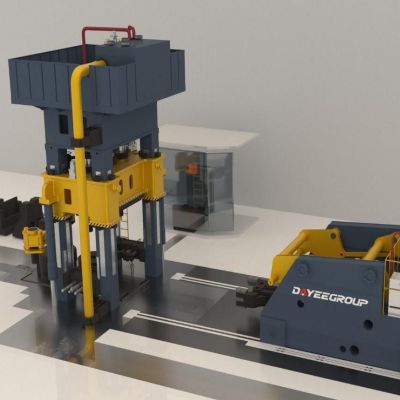
Copper alloy forging, a key process in precision manufacturing, requires careful consideration of material properties, process requirements, and production efficiency when selecting hydraulic presses. This article systematically explains the technical standards and configuration schemes for hydraulic press selection based on the forging needs of brass, bronze, and special copper alloys, providing professional decision-making guidance for industry professionals.
Introduction to Copper Alloys:
They possess excellent electrical and thermal conductivity, corrosion resistance, and wear resistance.
Brass (copper-zinc alloy): Forged brass is used in valves, pipe fittings, and gears.
Bronze:
· Tin bronze (copper-tin alloy): Good wear resistance, used in bearings and gears.
· Aluminum bronze (copper-aluminum alloy): High strength, wear and corrosion resistant, used in marine fittings and heavy-duty gears.
· Copper-nickel alloys (such as cupronickel): Excellent resistance to seawater corrosion, used in ships and desalination equipment.
1. Analysis of the characteristics of copper alloy forging process
Copper alloy forging faces three core challenges:
lHigh thermal conductivity: Heat dissipation rate is 5-8 times higher than that of steel, requiring rapid forming.
l Narrow processing temperature window: The temperature ranges for brass (650-800℃), bronze (700-850℃), and beryllium copper (600-750℃) differ significantly.
l Surface integrity requirements: High sensitivity to oxidation and stringent requirements for controlling surface defects.
2.Standard of key technical parameters of hydraulic press
Technical dimension | Standard requirements | Technical base |
Nominal tonnage | According to the theoretical value ×1.3-1.5 safety factor | ASTM E380 standard |
Speed control | Idle stroke ≥400mm/s, and the working speed is adjustable from 1 to 100 mm/s. | Heat loss compensation demand |
Temperature management | The mould is preheated to 150-400℃, and the oil temperature is controlled to 3℃ | Material phase transition temperature range |
Accuracy class | Parallelism of slider is less than or equal to 0.15mm/m, and repeatability is ±0.3mm | ISO 12100 safety standard |
Control system | Full closed loop servo system, response time ≤10ms. | Process stability requirements |
3. Graded Configuration Schemes
3.1 Standard Level Configuration (500-1500 tons)
Applicable Materials: Ordinary brass, leaded brass
Core Configuration: Proportional valve control system + mechanical synchronization mechanism
Production Cycle: 12-15 cycles/minute
Typical Applications: Architectural hardware, general-purpose valves
3.2 Precision Level Configuration (800-2500 tons)
Applicable Materials: Aluminum bronze, silicon bronze, high-zinc brass
Core Configuration: Servo proportional system + hydraulic synchronization control
Precision Assurance: Real-time pressure compensation + temperature monitoring
Typical Applications: Marine fittings, high-pressure valves
3.3 Professional Level Configuration (1000-3000 tons)
Applicable Materials: Beryllium copper, copper-nickel alloy, composite copper materials
Core Configuration: Multi-channel intelligent servo + isothermal forging module
Special Functions: Inert gas protection + rapid mold change system
Typical Applications: Aerospace components, electronic connectors
4. Selection and Verification Process
l Material Testing Phase (2-4 weeks)
u Rheological stress curve determination (Gleeble test)
u Mold material compatibility verification
l Process Simulation Phase (1-2 weeks)
u DEFORM/Simufact forging simulation
u Mold stress field analysis
l Equipment Verification Phase (3-5 days)
u No-load accuracy testing (laser tracker)
u Load characteristic testing (strain gauge measurement)
5. Technical and Economic Analysis
Taking the production of 500,000 brass valve bodies per year as an example:
Basic configuration (1500-ton four-column hydraulic press): Investment of 1.8-2.2 million RMB, payback period of 2.8 years
Upgraded configuration (2000-ton frame servo hydraulic press): Investment of 2.8-3.5 million RMB, payback period of 3.5 years
Professional configuration (2500-ton isothermal forging hydraulic press): Investment of 4.5-5.5 million RMB, payback period of 4.2 years
6. Industry Development Trends
Intelligent upgrading: Integrated AI process optimization system, real-time adjustment of forging parameters
Green manufacturing: Waste heat recovery efficiency increased to 40%, lubricant consumption reduced by 30%
Modular design: Rapid conversion of copper-aluminum and copper-steel composite forging capabilities
The selection of copper alloy forging hydraulic presses is essentially a systematic integration of materials science, mechanical engineering, and production economics. A phased implementation plan is recommended: initially focusing on basic process requirements, upgrading control precision in the medium term, and planning for intelligent production capabilities in the long term. The equipment supplier's industry experience, technical support capabilities, and spare parts supply system should be considered equally important as the equipment performance parameters.
DAYI heavy forging technology located in the famous capital of heavy industry in China, Xuzhou city. After years of development and integration, has grown into the domestic industrial automation equipment industry star. Our press are mainly used in shafts for ship engines and power station turbines, or flawless and reliable components for aerospace applications,satisfying various forging technical requirements, such as upsetting, drawing out, piercing, saddle forging, bending, offset forging, etc. finished +20000 sets Delivery, served +2000 customers.
Our heavy hydraulic alloys forging Machine support customized 300~30000 tons for demand from aerospace, Electric vehicles, ships, high-speed rail, wind power, nuclear energy, composite, Ti alloy forging, household appliances, general industrial forging.Welcome to our factory for a visit.
Contact: Mr. Alexander King
Phone: +86 17621575373
Tel: +86 17621575373
Email: alexander@dayiforgingtech.cn
Whatsapp:+86 17621575373
Add: Room 1-124, Changkai Building, Gulou District, Xuzhou City, Jiangsu Province, China
We chat