Email:alexander@dayiforgingtech.cn
Language: 



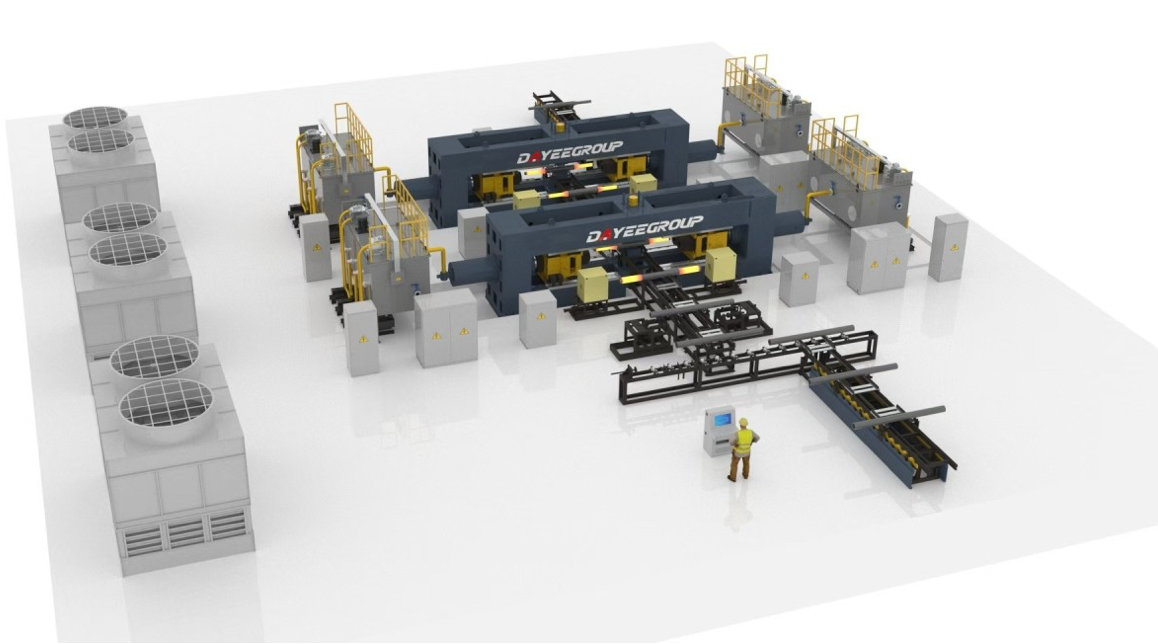
Traditional axle manufacturing processes are primarily divided into four categories: open-die forging followed by multiple machining operations; single-side flat forging or die forging (requiring repositioning and reheating); friction-welded assembled axles; and thickening by lathe machining of seamless steel tubes. Horizontal double-end extrusion is a process that involves simultaneous hot extrusion at both ends to form a single, integral piece.
I. Advantages in Metallographic Structure and Mechanical Properties
Complete and continuous metal flow lines result in a significantly extended fatigue life.
Traditional single-side forging, turning, and friction welding have obvious shortcomings: single-side forging requires turning the workpiece over, causing distortion and misalignment of metal flow lines; lathe cutting directly severs metal fibers; and friction welding results in interrupted flow lines at the weld seam and stress concentration at the weld.
With double-end extrusion, both ends are subjected to synchronized pressure, allowing the metal to flow uniformly in the axial direction. The flow lines follow the direction of the axle’s load path, completely enveloping the axle head and shoulder without any breaks or bends. Field tests show that the fatigue cycle life of the axles is 200% to 300% higher than that of conventionally forged axles. They are resistant to cracking under heavy-load vibrations and long-term alternating loads, making them well-suited for heavy-duty freight applications.
No welding defects: Fully integrated extrusion molding eliminates the risks associated with friction welding—such as slag inclusion, lack of fusion, and weld embrittlement—resulting in a higher non-destructive testing pass rate.
II. High dimensional accuracy, stable geometric tolerances, and a significant reduction in subsequent machining requirements
Simultaneous forming of both ends in a single setup eliminates errors caused by turning the workpiece over
Traditional flat forging and open-die forging require the workpiece to be turned over, and the two setups inevitably lead to deviations in coaxiality and perpendicularity. This often results in bent axles or misalignment between the two ends, requiring subsequent straightening and grinding, which leads to a high scrap rate. Horizontal dual-head cylinders with synchronized left-right feed allow the entire shaft to be positioned once to complete the forming of both ends simultaneously. This improves the precision of coaxiality, roundness, and end-face parallelism by several times, minimizes bending deformation, and eliminates a significant number of correction processes.
The forming allowance is uniform and controllable, significantly reducing machining allowances.
Traditional single-end free forging typically requires a machining allowance of 10–15 mm per side, resulting in severe material waste; dual-end extrusion offers high net forming precision, allowing the machining allowance per side to be controlled at 2–4 mm, reducing turning and grinding time by more than 50%.
III. Streamlined Process Flow, Doubled Production Efficiency, and Lower Energy Consumption
Typical Lengthy Steps in Traditional Processes
Steel tube blanking → Heating the entire tube → Swaging one end → Cooling and transfer → Reheating the other end → Second swaging → Multiple passes of open-die drawing → Heat treatment → Straightening → Extensive turning; for friction welding, two additional shaft sections must be forged separately + beveling + welding + post-weld non-destructive testing.
Streamlined Process with Double-End Extrusion
Cutting of steel tubes/round bars → Single-pass medium-frequency heating of the entire workpiece → Simultaneous extrusion of both shaft ends on a horizontal double-end extruder → Heat treatment.
Number of Heating Cycles Halved, Energy Consumption Significantly Reduced
Traditional separate forging of both ends requires 2 or even 3 heating cycles, resulting in high gas and electricity costs; Double-end extrusion requires only a single overall heating cycle, reducing total heating energy consumption by 30%–45%.
Shorter cycle time per piece, doubled production capacity
No need to flip, transport, or reposition the workpiece; hourly production capacity per machine is 80%–120% higher than single-end forging; easily integrated with loading/unloading robots and automated production lines to achieve continuous, unmanned mass production, making it ideal for high-volume automotive parts factories.
Process consolidation reduces the need for transfer fixtures and minimizes space occupied by multiple machines
Traditional setups require 2 heating furnaces, 2 forging hammers or single-head presses, and transfer roller conveyors; dual-head extrusion requires only one heating furnace and one main machine, resulting in a smaller footprint in the workshop.
IV. Higher Material Utilization and Lower Raw Material Costs
Traditional open-die forging and hammer forging produce large flash and require significant machining allowances, resulting in a material utilization rate of only 58%–65%. In contrast, double-end closed-die extrusion enables controlled metal flow, produces minimal flash, and increases material utilization to 78%–88%, offering a significant cost advantage in steel procurement for high-volume production.
Friction welding requires preparing two short shafts, with welding allowances reserved at both ends, resulting in additional material consumption; integral extrusion uses a single piece of steel tubing for forming, eliminating the need for splicing and associated material waste.
Contact: Mr. Alexander King
Phone: +86 17621575373
Tel: +86 17621575373
Email: alexander@dayiforgingtech.cn
Whatsapp:+86 17621575373
Add: Room 1-124, Changkai Building, Gulou District, Xuzhou City, Jiangsu Province, China
We chat