Email:alexander@dayiforgingtech.cn
Language: 



Choosing a suitable hydraulic press is a crucial investment for enhancing product competitiveness and expanding production capabilities. This is by no means a simple matter of "selecting a larger tonnage," but rather an engineering decision that requires systematic analysis.
Step 1: Defining the core problem – What do you intend to use this hydraulic press for? (This is the most crucial step)
Hydraulic presses have a wide range of applications, so you must first clearly define your core process:
Forging/Upsetting: Heating and upsetting the end of a steel bar to manufacture flanges, gear blanks, etc. Requires high tonnage, high rigidity, and a large working space.
Punching/Piercing: Punching holes in bar stock. Requires high precision and an ejection device.
Bending: Cold or hot bending of steel bars into arcs or rings. Requires specialized bending dies and possibly a movable worktable.
Press Fitting/Disassembly: Pressing bearings or bushings into or out of place. Requires control of pressing speed and stability.
Powder Forming: If you also produce powder metallurgy products. Requires high precision and multi-axis control.
Multi-process Composite: A single machine capable of flexibly handling multiple tasks listed above.
Step two: Core parameter selection – quantitative analysis at the technical level
Once the process is determined, the technical parameters can be quantified.
Nominal Force (Tonnage):
This is the most important parameter. It must be greater than the maximum force required to deform the material.
Simple estimation formula: Required pressure ≈ Tensile strength of the material × Cross-sectional area of the deformation zone × Process coefficient
Process coefficient: 4-8 for open die forging; 3-5 for closed die forging; 1.2-1.6 for blanking.
Example: To upset the end of a Φ50mm 45# steel bar (tensile strength approximately 600MPa), the deformation area is approximately 1963mm², and the process coefficient is taken as 6.
Required pressure ≈ 600 N/mm² × 1963 mm² × 6 ≈ 7,066,800 N ≈ 720 ton
Recommendation: Add a safety margin of 20%-30% to the calculated value. In the example above, a hydraulic press of over 900 tons should be selected. For steel bar processing, the tonnage typically ranges from 200 tons to 3000 tons, with a common range of 500-1500 tons.
2. Worktable Dimensions & Opening Height:
Worktable dimensions: Must be large enough to accommodate your largest mold, with space for mounting plates.
Opening height: Determines the maximum height of the workpiece or mold assembly that can be inserted. Opening height = Maximum opening height of the movable beam - Worktable height.
3. Stroke:
The maximum distance the movable beam can travel. This must accommodate the maximum compression required for your process (such as upsetting length) and the space needed for loading and unloading materials.
4. Speed:
Idle downward/return speed: Affects cycle time; the faster the speed, the higher the efficiency.
Working speed: This is a core process parameter. Forging requires a faster speed to reduce heat loss; precision pressing requires a low and adjustable speed to ensure accuracy. The wider the adjustable speed range, the more adaptable the machine.
Step 3: Structure Type Selection – Determining the machine's performance and purpose
Four-column hydraulic press:
Advantages: Simple structure, lower cost, spacious operating area, easy access to the mold from all four sides, and convenient maintenance. It is ideal for multi-purpose applications and situations requiring frequent mold changes, making it the most versatile option.
Disadvantages: Slightly less rigid than frame-type presses; prolonged operation under unbalanced loads can affect accuracy and lifespan.
Recommendation: If you have a wide range of processing needs and small production batches, and require a versatile machine, a four-column press is the best choice.
Frame-type (integral frame) hydraulic press:
Advantages: Excellent rigidity, high precision, strong resistance to off-center loading, and long guiding accuracy. Compact and modern appearance.
Disadvantages: High cost, relatively limited space for mold installation, and difficulty in transporting extra-large tonnage machines.
Recommended for: Processes requiring extremely high levels of parallelism and positional accuracy, such as precision stamping, press fitting, and powder molding.
Single-column (C-frame) hydraulic press:
Advantages: Open on three sides, extremely convenient to operate, especially suitable for bending and straightening long bar materials.
Disadvantages: Poorest rigidity, the opening is prone to deformation, and can only withstand loads near the center.
Recommendation: Unless you primarily perform lateral processing of long bar materials, it is not recommended as your main equipment.
Step 4: Control System and Function Configuration – The Key to Intelligence and Efficiency
Control Methods:
Manual/Semi-automatic: Suitable for single-piece and small-batch production.
Fully Automatic (PLC Control): Programmable control of pressure, speed, stroke, and holding time. Significantly improves consistency, efficiency, and safety in mass production. Highly recommended.
Servo Hydraulic System: The highest-end configuration, using a servo motor to drive the oil pump, resulting in energy savings (up to 70% power savings), low noise, and precise control. If the budget is sufficient and electricity costs are high, the long-term return on investment is high.
Safety Devices: Very important to consider
Light curtain/safety light barrier
Two-hand operation buttons
Emergency stop button
Hydraulic system safety valve, mechanical safety lock
Optional accessories:
Mobile workbench: Allows for the installation of multiple molds, enabling quick switching and significantly improving efficiency.
Ejection cylinder: Used for demolding or achieving bidirectional pressing.
Stroke/pressure digital display device: Facilitates process parameter recording and quality traceability.
Heating furnace integration: If performing hot forging, consider the loading/unloading mechanism and temperature control coordination.
Step 5: Supplier and After-Sales Service Evaluation
Manufacturer Qualifications: Review their history, technical capabilities, and successful case studies, especially those in the same industry.
Key Component Brands: The brands of the main oil pump, hydraulic valves, seals, motor, and PLC determine the reliability and lifespan of the machine.
After-Sales Service: Installation and commissioning, technical training, warranty period, and spare parts supply speed. A machine will be used for over a decade, so service is more important than the initial price difference.
Summary and Action Recommendations
Define Your Needs: List the material of the steel bars you need to process, the maximum diameter, core processes, and target daily/monthly production volume.
Calculate Tonnage: Estimate using a formula and consult with technical personnel from 2-3 reputable hydraulic press manufacturers. Have them recommend the tonnage and machine model based on your needs.
On-Site Inspection: Whenever possible, visit the supplier's factory to observe the machine in operation, especially conducting sample tests with materials similar to yours. This is the most direct way to verify the machine's capabilities.
Compare Solutions: Obtain technical solutions, configuration lists, quotations, and after-sales service terms from different suppliers for comprehensive comparison.
Plan for the Future: Consider potential business expansion in the next 3-5 years and whether the machine has room for upgrades (such as adding CNC systems, robotic arms, etc.).
Finally, remember this principle: Buy a machine for your "application," not for its "parameters." The best hydraulic press is the one that best suits your specific production process.
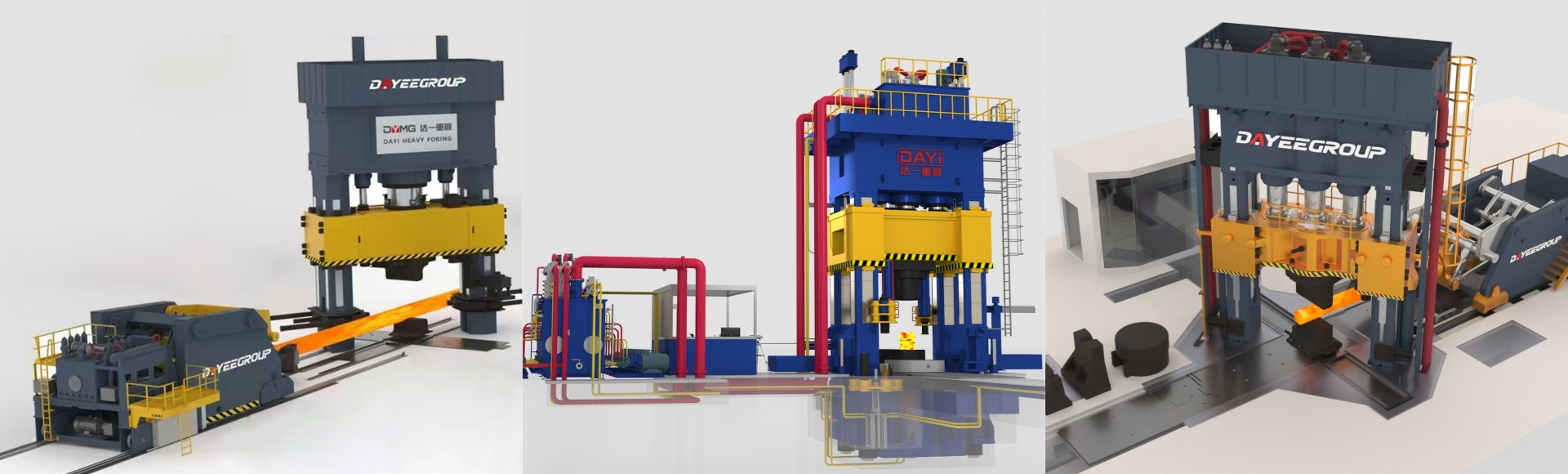
DAYI Heavy Forging Technology focused on the R&D, manufacturing and sales of heavy hydraulic stamping presses, high-speed open die forging presses, closed die forging press, forging manipulator, forging transfer and related auxiliary, for sheet metal fabrication and forming industry since 2005 in China.
Our hot sale products as below:
1. 630-30000 tons hydraulic stamping presses.
2. 1250–15000 tons Hydraulic open die forging press.
3. Titanium alloys and superalloys forging press.
3. Composite materials forming hydraulic press.
4. Closed dies and free hydraulic forging press.
5. 5~400 tons full hydraulic forging manipulator.
6. 5~400 tons forging transfer.
7. Tube end thickening upsetting hydraulic press machines.
8. Automatic shafts & trailer axle extrusion hydraulic press.
Our heavy hydraulic press forging Machine support customized 300~30000 tons for demand from aerospace, Electric vehicles, ships, high-speed rail, wind power, nuclear energy, composite, Ti alloy forging, household appliances, general industrial forging.If you have any technical needs, please feel free to contact us.Welcome to visit our factory for a tour and inspection.
Contact: Mr. Alexander King
Phone: +86 17621575373
Tel: +86 17621575373
Email: alexander@dayiforgingtech.cn
Whatsapp:+86 17621575373
Add: Room 1-124, Changkai Building, Gulou District, Xuzhou City, Jiangsu Province, China
We chat